
What is a Bill?
A Bill is a proposed Act. A Bill proposes to make a new law or change an existing one, and is prepared for consideration by Parliament. It can change as it passes through Parliament.
Types of Bills
There are four types of Bills.
Government Bills: A Bill introduced by a member of Parliament in their capacity as a Minister. A government Bill deals with matters of public policy and becomes a public Act if enacted.
Members' Bills: A Bill promoted by a member of Parliament who is not a Minister. A member’s Bill deals with matters of public policy and becomes a public Act if enacted.
Local Bills: A Bill promoted by a local authority to deal with specific issues in their area. It is introduced by a Member of Parliament. It becomes a local Act if enacted.
Private Bills: A Bill promoted by a person or a body of persons for the particular interest or benefit of that person or body of persons. It is introduced by a Member of Parliament. It becomes a private Act if enacted.
This website provides all current Bills, all Bills published since 1 January 2008, and many other Bills that are no longer current. You can search for Bills by type on the Advanced Search page.
See also Bills and Laws on the Parliament website for the current schedule of Bills at Parliament. See also How New Zealanders can contribute to legislation.
A Bill passes through several stages in Parliament before becoming an Act
A Bill usually passes through several stages in Parliament before becoming an Act. These stages ensure that a Bill is subject to public debate and scrutiny. Some of these stages also provide an opportunity for a Bill to be changed.
These stages are: introduction, first reading, select committee, second reading, committee of the whole House, third reading, and Royal assent. See How a bill becomes law on the Parliament website for more detail on these stages.
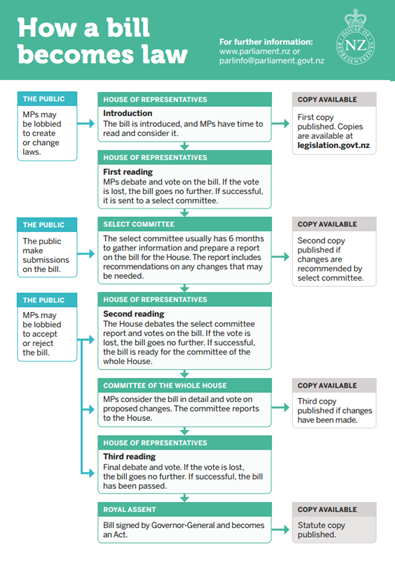
Source: Office of the Clerk, Parliament.nz
Each Bill has its own page on the Parliament website that shows its progress, and also links to debates in Parliament, submissions, and advice relating to the Bill. See Bills (proposed laws) - New Zealand Parliament.
A Bill is usually republished as it passes through Parliament, to show the changes made to it.
At introduction: a Bill begins with a reference number and an explanatory note
The first stage of a Bill is when the Bill is introduced to Parliament and first published.
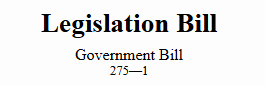
At introduction, the Bill receives a two-part reference number. The first part is unique to the Bill for that Parliamentary term, and the second identifies the specific version of the Bill. So, for example, Bill 275—1 is the first published version of Bill number 275.
At Introduction, the Bill begins with an explanatory note. The explanatory note:
states the policy the Bill seeks to achieve – the general policy statement
explains the individual provisions of the Bill – the clause by clause analysis
usually links to documents that provide more information about the Bill – a departmental disclosure statement and regulatory impact assessment.
After the explanatory note comes:
name of the person in charge: a Minister (for Government Bills) or another Member of Parliament
Bill title
type of Bill
Bill number.
Select committee report: the Bill includes commentary
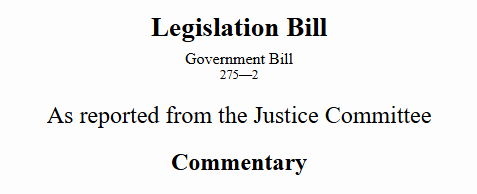
After a select committee has considered the Bill, which usually includes hearing and considering public submissions on the Bill, it reports back to Parliament on the Bill and the Bill is republished. The Bill now begins with the select committee’s commentary. The select committee’s commentary describes the issues that submitters have raised or the committee has considered and explains the changes to the Bill that the committee recommends.
The Bill version number advances by 1, for example to 275—2.
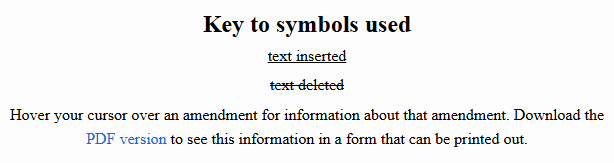
If the select committee proposes amendments, their changes are shown in the text using underlined and struck out text. A key before the contents page explains how the amendments are shown.
Committee of the whole house: further changes may be made
At this stage, the committee of the whole House debates the Bill. Amendments may be proposed and discussed. Amendments are often, but not always, in the form of Amendment Papers (see below).
Once the final form of the Bill is agreed on, the Bill may be republished to show any changes that have been agreed. If republished, again the Bill number advances by 1, for example to 275—3. Agreed changes are shown by underlined and struck out text.
Royal assent: final changes are taken in before the Bill becomes an Act
After the committee of the whole House, and the Bill passing third reading, a version is prepared for Royal assent. The changes agreed earlier are taken, and the numbering of provisions and cross-references is updated to reflect those changes. This text becomes the next published version, which after Royal assent is no longer a Bill, but an Act.
A Bill’s structure reflects the Act it will become, with some differences
All PCO-published legislation shares a legislative structure. Bills have a similar structure to the Acts that they become if enacted, but some units are different.
Bill titles
Bill titles do not include a year, though the year when the Bill was introduced is part of the Bill's data. If the Bill becomes an Act, the Act title includes the year when it is enacted. On this website Advanced Search allows you to search for a Bill by the year it was introduced. If a later version of that Bill is published in a later year, the identifying year remains the year it was introduced.
Special bold font used for details that may change
In a Bill, some details such as internal cross references and the year in the title clause are shown in a different, bold font. This formatting marks details that are likely to change before the Bill becomes an Act. These details are checked and corrected before the resulting Act is published.
Bill clauses
A Bill’s basic unit is the clause. Inside a Bill, clauses are numbered and have a bold heading. They can also be called provisions. When a Bill becomes an Act its clauses become sections.
A Bill’s first clause is the title clause, naming the Act it is intended to become.
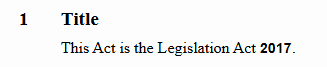
Note that the year shown here is the year that the Bill was introduced. It will later be replaced by the year the Act is finally enacted, if this happens.
A clause can include:
subclauses: numbered as (1), (2) below clause numbers
paragraphs: numbered as (a), (b) below clause numbers and often below subclause numbers; if there are more than 26 paragraphs, numbers are used instead of letters
subparagraphs: (i), (ii) below paragraphs
subsubparagraphs: (A), (B) below subparagraphs.

Amendment Papers set out proposed amendments to Bills
An Amendment Paper (AP) is a published document that sets out proposed amendments to a Bill. Amendment Papers were called Supplementary Order Papers (SOPs) before 2024.
On this website, Amendment Papers are labelled with the name of the Bill, followed by “Amendment paper” and number. An example would be “Valuers Bill - Amendment paper No 286”.
Features of an Amendment Paper
An Amendment Paper starts with:
reference number
headings: “House of Representatives”, “Amendment Paper”, the name of the Bill, and “Proposed amendment(s)”
name of the person proposing the amendments: a Minister (for Government Amendment Papers) or a Member of Parliament (for Members’ Amendment Papers).
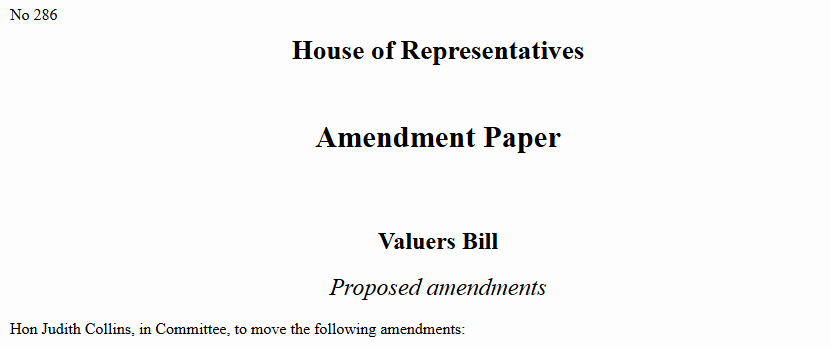
The Amendment Paper then details the proposed changes to the Bill. Usually this is a simple description of the changes, with text to be inserted shaded in grey. When there are proposed amendments from a Minister, the Amendment Paper may show the entire Bill with the proposed additions and deletions marked as inserted and struckout text.
Amendment Papers can also set out a proposal to divide a Bill into two or more Bills.
An Amendment Paper includes an explanatory note. This is at the end for most Amendment Papers, but at the start if the Amendment Paper shows the entire Bill. There may also be links to other information – a departmental disclosure statement or a regulatory impact assessment.
Find Amendment Papers on this site
Find Amendment Papers and the earlier SOPs using one of these three methods:
Use Advanced search.
Navigate to the relevant Bill, then look under the Amendment Papers tab.
Search for the Amendment Paper by the Bill name and the Amendment Paper number.
This website provides all APs and SOPs released since 2008.
See also Amendment Papers on the Parliament website.
What is a table amendment?
Members of Parliament can also propose amendments to a Bill that are not published as Amendment Papers, usually when there is not enough time to fully prepare the amendment for publication. These are called table amendments.
Table amendments are not published on this website. To find the text of a table amendment, see the Bill’s main page on the Parliament website.